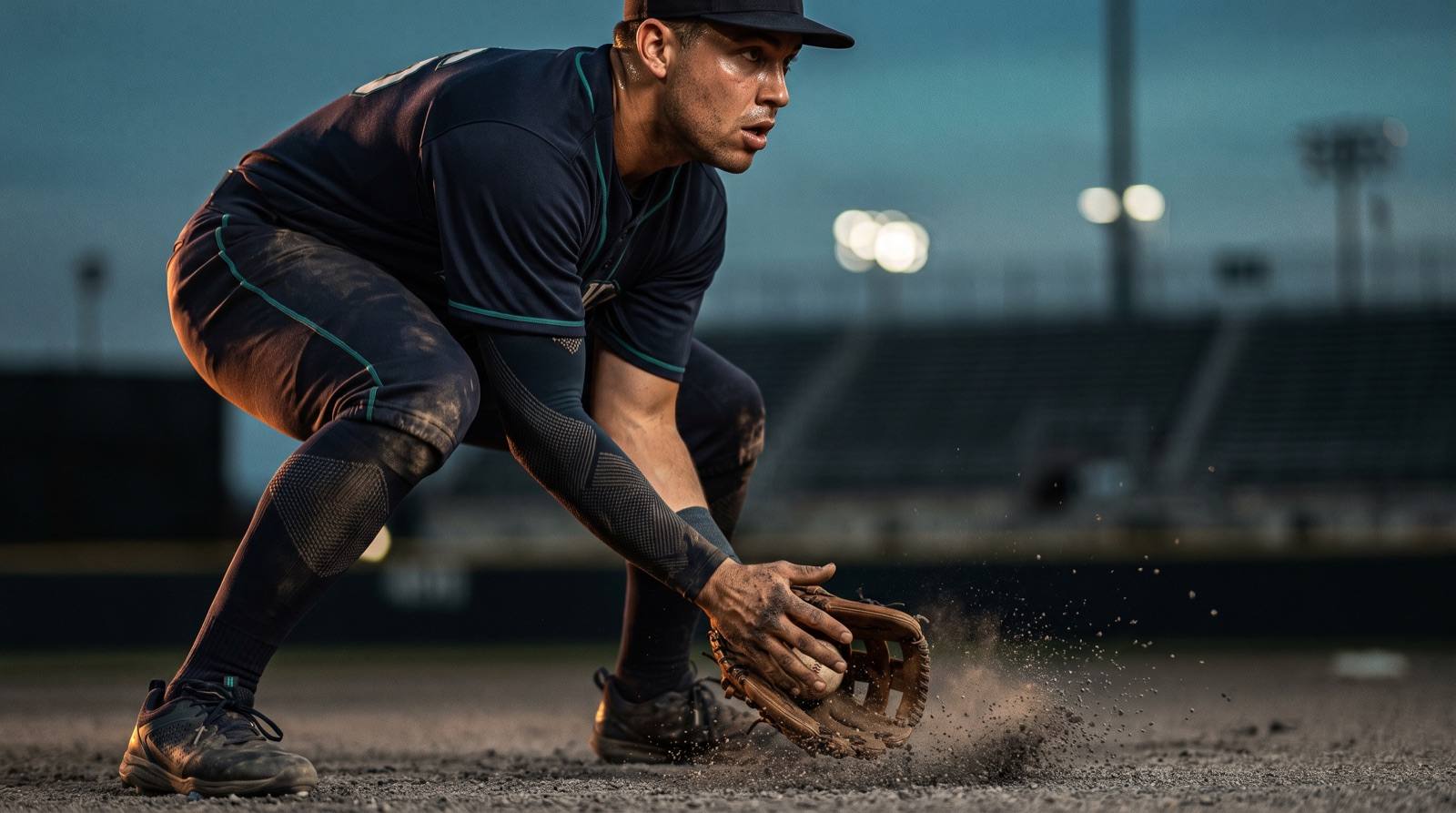
Baseball throwing mechanics: the chain that moves the ball.

A position player throw is not a mound delivery, and judging it by pitching rules gets it wrong. The chain is the same, roughly 80% of throwing velocity comes from rotational mechanics below the shoulder, but the crow hop and the transfer out of the glove are the parts that decide whether an infielder or outfielder gets rid of it on time.

Baseball Throwing Mechanics for Position Players
01

What changes from the mound.

The sequencing principle carries over exactly: legs and hips fire first, then trunk, then arm, with hand speed peaking last. Three things are genuinely different, and they are where most throwing faults live.

ElementOn a throw
The crow hopReplaces the windup. Its job is linear momentum toward the target, gathered before rotation starts. A throw with no momentum makes the arm supply everything.
The transferGlove to hand has to happen while the feet are already working. Most late throws are late in the transfer, not slow in the arm.
Arm slotGenuinely variable by position and by throw. A higher slot is not inherently better. An infielder throwing on the run should not look like a pitcher.
02

The six checkpoints.

These are the areas our throwing framework scores, in weight order. Each window is a reference range, not a template.

CheckpointWhat good looks likeMost common fault
Sequencing
weight 20
Hips peak, then trunk, then elbow, then hand, in clear order.Arm dominant throws, where hand speed ramps with no prior hip or trunk peak.
Hip to shoulder separation
weight 20
Hips opening ahead of the chest, peaking during the throw. 25 to 40 degrees on video corresponds to the 40 to 60 degree 3D reference.Hips and shoulders rotating as one unit, so nothing elastic is stored.
Crow hop, stride, and momentum
weight 15
A gather that builds speed toward the target and converts to rotation on landing.Standing and throwing with no momentum, or drifting sideways off the target line.
Trunk and posture
weight 15
Quiet head, forward flex over a stable base with moderate tilt.Staying tall, which shortens the acceleration path, or excessive tilt that loads the shoulder.
Arm action and timing
weight 15
Elbow near 90 degrees at shoulder height when the front foot lands, hand speed peaking last, glove side firm.Arm drag, where hand speed peaks well after the window it should.
Deceleration and finish
weight 15
Smooth decay with the chest continuing over the front leg toward the target.Recoil, or falling off to the side rather than finishing through the throw.
03

Drills that fix the throw.

01

Crow Hop Momentum Builds

Field a rolled ball, crow hop, and throw to a target at 75% effort, feeling the rear leg drive you forward before you rotate. Six reps, adding distance gradually.

Cue: gather and go, then fire.

02

Step Behind Shuffle Throws

Take a crossover step behind the stride foot, shuffle toward the target, and throw at 75% as the momentum carries you. The feet arriving first forces the hips to fire before the trunk can cheat.

Cue: feet first, hands last.

03

One Knee Late Whip Throws

From the throwing side knee, rotate the chest back, show the goalpost, and throw at 60%, letting the hand come through last. Ten easy reps.

Cue: chest turns, then the whip cracks.

04

Glove Stabilize Drill

Throw at 75% with one rule: the glove stops over the front foot at chest height and the chest travels to meet it. A partner watches that the glove never flies behind the hip.

Cue: bring your chest to the glove.

What video can and cannot measure

Everything above reads from a single camera as a 2D approximation, labeled that way, with basis landmarks and a confidence value on every number. What a clip cannot give you: arm health or workload, which need data from outside the video, and grip detail, which is below the resolution of a full body frame. Film from the side at 120 frames per second with the whole body in frame.

See it on your own infielders and outfielders.

Send one practice clip and we will return the full breakdown, so your staff judges the engine on your players rather than a demo reel.

Request a breakdown
04

Related guides.

How to throw harder

Where velocity comes from and the leaks that cost the most.

Pitching mechanics

The same chain on the mound, with six checkpoints and windows.

Swing mechanics

The hitting side: load, sequence, contact, balance, timing.

05

Common questions.

What is the difference between pitching and throwing mechanics?
The kinetic chain is the same: hips, then trunk, then arm, with the hand peaking last. What differs is the start and the slot. A throw uses a crow hop or step for momentum instead of a windup, adds a glove to hand transfer under time pressure, and allows a much wider range of arm slots depending on the position and the throw.
What is a crow hop and why does it matter?
A crow hop is the gather step that builds momentum toward the target before the throw rotates. It matters because momentum created by the legs is momentum the arm does not have to create. A throw made flat footed forces the arm to supply everything.
Why are my player's throws late?
Usually the transfer, not the arm. Glove to hand has to happen while the feet are already working toward the target. Time the whole sequence from the catch rather than from the release and the delay usually shows up before the arm ever moves.
Should outfielders throw over the top?
Only if it is natural to that athlete. A higher slot is not inherently better, and the right slot depends on the position and the specific throw. An infielder throwing on the run should not be expected to look like a pitcher.
Can you measure throwing mechanics from a phone clip?
Yes. Film from the side with the whole body in frame at 120 frames per second against a clean background. The engine reads joint angles, segment speeds, phase timing, and the sequence order from a single camera, labeled as 2D estimates.